

 WoW Midnight
 The Burning Crusade
 Mists of Pandaria
 WoW Classic Era
 Path of Exile 2
 Path of Exile 1
 Diablo 4
 Diablo 2
 Arc Raiders
 Destiny 2
 Where Winds Meet
 Final Fantasy XIV
 Last Epoch
 Dune Awakening
 Counter Strike 2
 League of Legends
 Valorant
 Monster Hunter Wilds
 Marvel Rivals
 Once Human
 New World
Diablo 4’s Lord of Hatred Isn’t Playing It Safe — And That’s Exactly the Point

INTRODUCTION
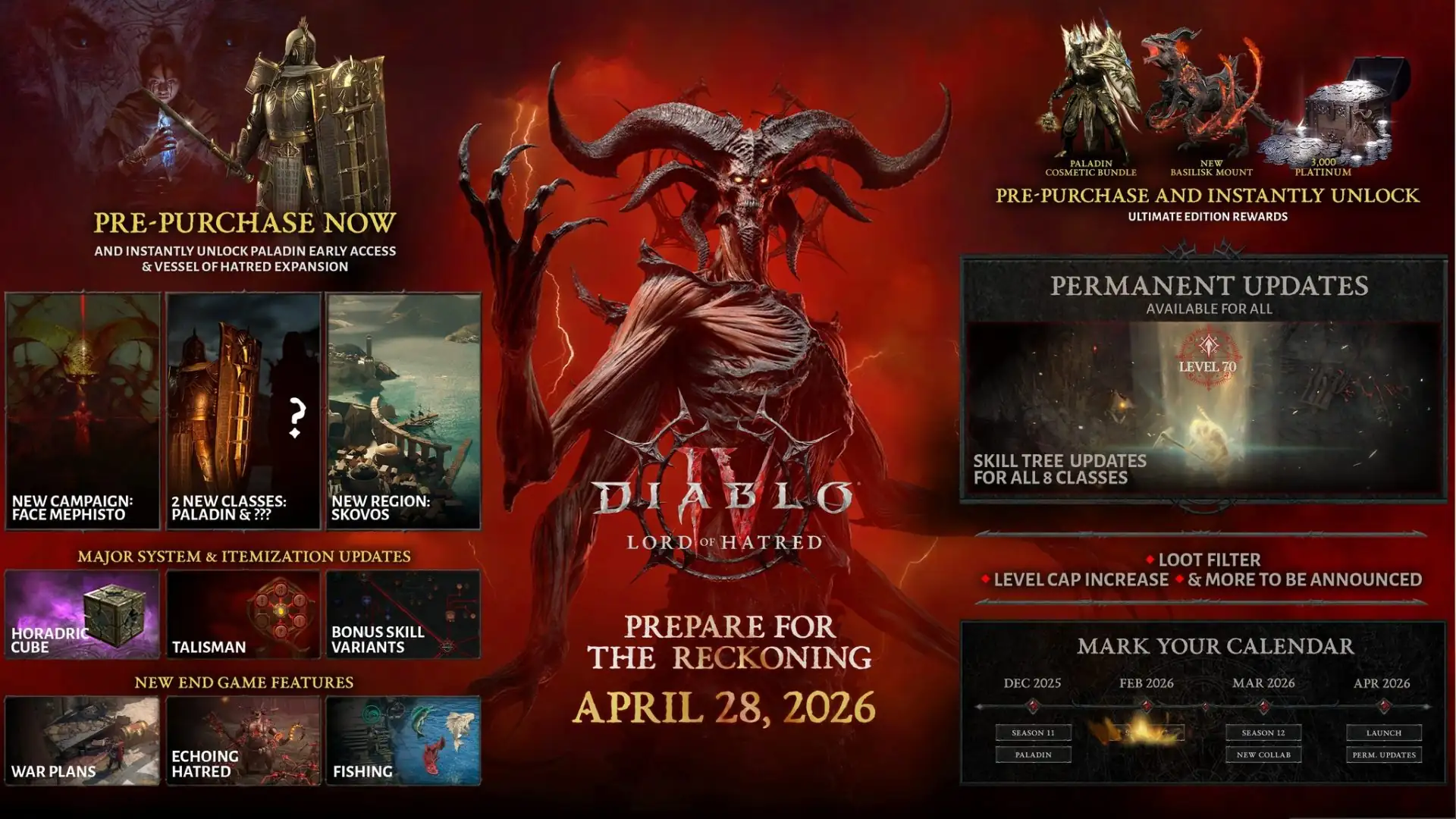
Blizzard has officially lifted the curtain on Diablo 4: Lord of Hatred, and for once, the expansion reveal feels less like cautious iteration and more like a deliberate course correction. After months of community criticism surrounding itemization depth, endgame variety, and build expression, Lord of Hatred positions itself as an answer rather than an apology. Whether it succeeds will depend on execution—but on paper, this is easily the most ambitious update Diablo 4 has seen since launch.
The expansion builds directly on Vessel of Hatred and pushes the story toward a final confrontation with Mephisto, while simultaneously rebuilding core systems that players interact with every day. From skill trees and crafting to endgame progression and loot visibility, Lord of Hatred signals Blizzard’s willingness to rethink fundamentals instead of just adding more layers on top.
A New Campaign and the Road to Mephisto
Lord of Hatred continues the narrative after Vessel of Hatred, pulling players into a darker and more personal chapter of Sanctuary’s fate. Mephisto’s influence is no longer distant or symbolic—his presence is actively shaping events, cultists, and entire regions.
The campaign is set in Skovos, a long-rumored land steeped in ancient lore and internal conflict.
Key story elements:
Direct continuation of Vessel of Hatred’s ending
Focus on Mephisto’s imminent rebirth
Political and mythological tension within Skovos
Unlikely alliances, including cooperation with Lilith
Rather than retreading familiar demonic invasions, Blizzard appears to be leaning into ideological conflict, prophecy, and long-term consequences—something Diablo’s lore has often hinted at but rarely explored deeply.
Skovos: A New Region With Old Blood
Skovos is introduced as a full open-world region, not a side zone or instanced area. Visually and thematically, it stands apart from previous Diablo 4 regions, blending coastal ruins, volcanic landscapes, and storm-ravaged forests.
What defines Skovos:
Homeland of the Amazons and early human civilization
Ruled by the Amazon Queen and the Oracle Queen
Mix of coastal, volcanic, and drowned environments
New towns, dungeons, enemies, and world events
From a gameplay perspective, Skovos isn’t just scenery—it’s positioned as a core pillar of progression, housing campaign content, endgame activities, and future seasonal hooks.
Two New Classes, One Available Right Now
Lord of Hatred introduces two new playable classes, though Blizzard is only ready to fully reveal one of them.
The Paladin (Available via Pre-Purchase)
The Paladin marks a return to classic Diablo identity, but with modern mechanical twists. It’s not just a nostalgia play—this is a fully reimagined class with new systems layered on top of familiar abilities.
Paladin highlights:
Sword-and-shield playstyle with flails added as a new weapon type
Signature abilities like Zeal, Blessed Hammer, Blessed Shield, and Auras
Arbiter Form allows temporary angelic transformation
Faith and Oath systems introduce build-defining choices
The Paladin is playable immediately for players who pre-purchase the expansion, giving Blizzard months of live data before full release.
The Second Class (Launching April 2026)
Blizzard has confirmed a second class will arrive with the expansion launch, but details remain intentionally vague.
What we know so far:
Launches alongside Lord of Hatred in April 2026
Lore-aligned with the Skovos region
Community speculation points to Amazon or Witch Doctor
This slow reveal feels intentional, likely designed to maintain momentum rather than front-load every announcement at once.
Endgame Gets Rewritten, Not Expanded
One of the most notable shifts in Lord of Hatred is how Blizzard approaches endgame content. Instead of adding another isolated activity, the expansion restructures how players choose and progress through endgame systems.
War Plans: Choose Your Path
War Plans allow players to shape their endgame experience by prioritizing specific activities and modifying them for higher rewards.
War Plans introduce:
Player-controlled progression paths
Modifiers that increase difficulty and reward scaling
Skill-tree-like customization for endgame activities
This system aims to reduce the feeling of “mandatory content” while still rewarding focused playstyles.
Echoing Hatred
Echoing Hatred functions as a relentless gauntlet mode, designed to push builds to their limits.
Core traits:
Endless waves of increasingly dangerous enemies
Build stress-testing rather than loot bursts
High-risk, high-reward structure
It’s clearly positioned as a skill and optimization check rather than a casual farming tool.
Fishing (Yes, Really)
Fishing appears briefly in the infographic—and that’s all Blizzard is saying for now.
Confirmed details:
Fishing exists
It is optional
It is not a joke
Whether it becomes meaningful progression content or a side activity remains to be seen, but its inclusion signals a broader view of endgame pacing.
Core Systems Are Finally Getting Attention
Rather than locking major improvements behind the expansion, Blizzard is rolling out several system overhauls for all players.
Skill Tree Rework
Every class receives a redesigned skill tree with deeper branching and more meaningful choices.
Changes include:
New class-specific skill variants
Expanded node functionality
Increased level cap to 70
This directly addresses long-standing concerns about shallow build diversity.
Horadric Cube Returns
The iconic Horadric Cube makes its return, reintroducing experimental crafting and recipe-based item manipulation.
Expected functionality:
Item combination and transformation
Recipe-based crafting depth
Encouragement of experimentation
It’s a clear nod to Diablo II’s strongest systems.
Talisman System and Set Bonuses
Talismans introduce structured set bonuses without reverting to rigid gear dependency.
What Talismans aim to do:
Enable build-defining bonuses
Avoid full-set lock-in
Add long-term optimization goals
This strikes a middle ground between Diablo II freedom and Diablo III set dominance.
Loot Filter (Finally)
The long-requested loot filter is officially coming.
Loot filter benefits:
Highlight desired stats and item types
Reduce screen clutter
Improve farming efficiency
For many players, this alone is a quality-of-life win worth celebrating.
Editions, Pricing, and Release Date
Release Date: April 28, 2026
Editions:
Standard ($39.99): Lord of Hatred + Vessel of Hatred
Deluxe ($59.99): Adds cosmetics, pet, mount, premium battle pass
Ultimate ($89.99): Includes Platinum, armor sets, portal skins, and more
All editions grant:
Immediate Paladin access
Extra stash tab
Additional character slots
World of Warcraft housing décor items
CONCLUSION
Lord of Hatred doesn’t feel like a routine expansion—it feels like Blizzard acknowledging that Diablo 4 needed more than seasonal tweaks. By reworking systems players interact with every hour, expanding build depth, and giving players agency over their endgame, the expansion finally addresses concerns that have lingered since launch.
That said, ambition alone doesn’t guarantee success. Systems like War Plans, Talismans, and the skill tree overhaul will live or die by balance, pacing, and long-term support. Still, for the first time in a while, Diablo 4 isn’t just promising more—it’s promising better.
Whether Blizzard delivers on that promise is a question for 2026. But for now, Lord of Hatred looks less like a safe bet—and more like a necessary risk.
Thank you for taking the time to read our posts and we’ll keep them coming, if you like our posts make sure to bookmark our InstantCarry blog. If you need help with Diablo 4, feel free to check our services.If we do not offer it on the site, you can Request a Service, or get in touch with our Livechat or Discord Support – we are active 24/7!
To finish things off, here’s the Diablo IV Story so Far – SPOILERS AHEAD!!